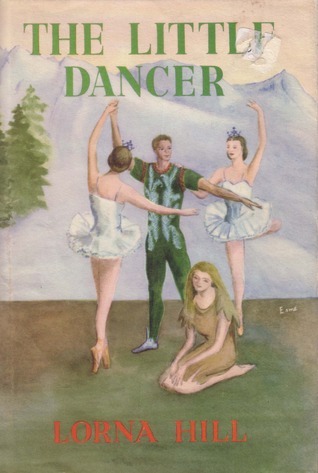
The Little Dancer by Lorna Hill
My rating: 3 of 5 stars
I don’t think there are many other writers around this period who understand ‘place’ quite like Lorna Hill does. Let me provide a little bit of backstory before we continue: when I was little, I remember an early trip to London and the sudden realisation that their local news was not our own. That little bit after the main news programme where people talked about places that we went to on the bus or that some of my friends lived in, was not the same the country over. Here we learned about the underground and traffic delays and news of protests marching down streets. I had thought that other people would have been bored by hearing our news, yes, but I had never thought that they got their own. I was, as Jean Piaget might recognise, right in the middle of an egocentric phase of my development. But there, there it was, somebody else’s local on the TV.
Ever since then I have become kind of fascinated by how the world can world a thousand different ways and do it at the same time. That you can travel for hours and days and emerge on the other side of the world to a world which is doing its own thing, its own kind of local. A thousand different locals all slowly connecting with each other to create this bigger, wonderful thing. I am fascinated by it all and, to return to this book, I think Lorna Hill writes local and space and place with an incredibly wonderful sense of style. You know precisely where she is and when she is and how comfortable she is there. London is beautiful and perfect but so is Northumberland and the borders and Scotland and somehow all of them are home. All of these places burning with their own character, beautiful as each other in their own ways but all of them full of a particular kind of heartache, a particular kind of crack in the glass, whether that’s the lonely hard work of Annette as she works in the rehearsal room before climbing back up the stairs to her rooftop room, or the shy, soft sadness of Sheila’s subplot and the realisation that her local is not about place but perhaps, about people.
I’m saying a lot here without saying much, I wonder, but then there’s something about Lorna Hill which scratches a very satisfying part inside of my head and makes me want to connect the dots, to pull all these threads together and see what happens, what might they make. And I think here, in particular, they start to make something so interesting about culture and performance and art and the value of it being made available to all, the transformative nature of cultural investment (really, it’s here), and the slow interrogation of artistic integrity.
This isn’t to say that this book is perfect because it is not; Hill is much better elsewhere (I think, in particular in the early Sadlers Wells titles), the plot is not the most startlingly interesting of things, and there is a startling racial sterotype used on the last page of this edition which sits at odds with the rest of the book and indeed her work as a whole. It’s a sticky final note and one that I felt on an almost physical level. I do not seek to excuse it but I do think it will take me a while to understand it, to scratch the new and painful itch it made inside my brain.
View all my reviews
 Daisy May Johnson
I don’t think that the Dancer books are a patch on the Wells books, but she does do a really good job of showing the difference between life in That London and life in rural Northumberland 🙂 .
Oh this! I can’t remember which book it’s in but there’s a moment where she talks about scones (?) singing with butter and that’s it, that’s precisely everything for me.