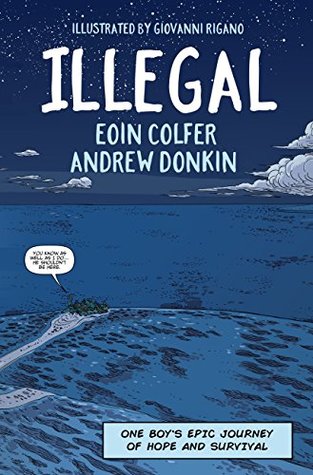
Illegal by Eoin Colfer and Andrew Donkin, illustrated by Giovanni Rigano
My rating: 4 of 5 stars
I have wanted to read this for a long while and finally came across a copy at my local library. I was familiar with Colfer due to his work upon Artemis Fowl and this title, I was familiar with, because I’ve seen a lot of good press for it. Sometimes that can detract from a book for me because The Discourse can sometimes be a little bit overwhelming of the text itself. I lose track of what the story is and I end up reading it through this kind of foggy filter that obfuscates the actual thing at the heart of it all. But time helps and distance helps and when I read this, I came to it and I found a lot of gentle, rather profound clarity within it.
I am looking for clarity more and more within stories at the moment, that ability to sit within a very precise moment and just inhabit it without rolling the text along. Perhaps this is as a result of reading a lot of other authors who will determinedly get you to the final page before you’ve even finished reading the first (no names but her name rhymes with Schmenid Schmyton), but I wonder if it’s also due to the amount of sheer stuff that’s in the world at the moment. We live with noise, a lot of it, and when some stories are told, others are silenced or, indeed, othered, and sometimes it takes time to hear and to trust and to determinedly tell those stories.
Colfer and Donkin deliver something very eloquent here and, although this may sound a strange word to use (stay with me), something rather soft. There is a gentleness about the colour palate, a sort of faded, sun-worn edge to it all where the colours are remembered and the story told in flashback until all of a sudden, the timelines merge and we reach a moment of trauma so potently rendered that it is quite the most powerful and simultaneously the most awful bit in the book.
The story moves towards an ending that some readers may suspect but one that, I think, Colfer and Donkin get away with because of the grace in which it is handled. It is a hopeful book this and one which finds hope even in the raw, ragged edge of things, and it is difficult to write hope and find hope in such situations but it is not impossible, I think, and it is often good.
 Daisy May Johnson