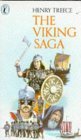
The Viking Saga: Viking’s Dawn / The Road to Miklagard / Viking’s Sunset by Henry Treece
My rating: 4 of 5 stars
I wasn’t surprised to discover that this trilogy was first published in the fifties. Some periods in British children’s literature wear their heart very much on the sleeve. If you cut them, they bleed time and place. That sort of thing. The children’s books of the fifties, particularly when they’re of a historical ilk, give you some very heightened, rich language and quite classic storytelling. Adult, almost, perhaps, although I always feel that that’s a bit of a messy word to use when it comes towards children’s literature (the myriad of meanings that it has, the clarification it needs…). I suspect what I’m trying to work towards here is big storytelling. Ferociously accurate and sometimes even unreaderly detail. Books that look back and try to understand what sort of people we were and how that’s made the people that we are now.
(I generalise, of course, forgive me, of course these are aims that apply to much of today’s children’s literature but I think that there is still something so very interesting in how marked it is in the books from this period).
The Viking Saga, then, is the story of a man but also a story of how to keep your faith in a complex world, how to keep hold of your believes and how the world can so often be stranger than fiction. It took me a while to get into it because it’s not written in a particularly friendly manner (I am increasingly intrigued by thinking of writing in terms of friendliness: I like the way it captures something of the two way exchange of it, the necessity to be both ready to give but also to receive..).
But the more I read of it and the more I thought about it, I began to realise that Treece is not really concerned about being friendly or making it easy and obvious for the reader but rather about telling the story in the shape and way that it must be told. And that’s not to say that he doesn’t want it to be read because he does or that he tells it poorly for he does not. He exerts notable effort to do so in both. But he asks you to make the effort to read it, to come and meet him where he is, towards understanding and figuring it out, to becoming part of this strange and unusual band of men, to becoming part of their journey and their dreams and their fears, and all of a sudden you do. You get it.
And then all of a sudden you’re sat on the edge of the bed, unable to move until you’ve read a few more pages, unable to move until you’ve figured out how it ends.
In terms of contemporary readalongs, I’d be interested to see this paired with something like Louie Stowell’s Loki: A Bad God’s Guide to Being Good and there’s also a comparative critique begging to be made with historical fiction from other periods because fifties books really do fifty so hard and I think there’s something super interesting in that.
View all my reviews


 Daisy May Johnson
Leave a reply to Calmgrove Cancel reply