My rating: 4 of 5 stars
When I was researching How To Be True, I read a lot about the experience of the common (wo)man in 1930s and 1940s Germany. It’s difficult to ever really grasp this period because there are somehow always new stories to discover, new – horrific – episodes to process, and moments of breathtaking never-been-told-before moments of bravery to realise, that all you can hope to do in your own work is write a little bit of that and recognise the rest of it, the wilderness of courage and of desperation and of endless horror that characterised so many lives during this time. So you write and you read and you research and you try to do it justice and then you come across things like Travellers In The Third Reich and you realise there’s yet more here, yet more to understand, yet more to comprehend about the depravities of man.
What Boyd offers is a high level look at the rise of the Third Reich through the eyes of travellers and visitors to Germany. The characters featured here range from Unity Mitford to Charlie Chaplin, the Lindberghs to W E B Du Bois, and you can tell that the author’s put her work in. There is a lot of information handled very well here and Boyd keeps a neat handle on it. There are a few moments when I wanted to go down some of the rabbit holes to a further extent (a moment, for example, when Boyd mentions a woman walking up to an English married couple and asking them to take her daughter home with them, my god, what is this) but I don’t think that’s entirely possible in the structure of a book like this as much as I might want it to be.
This is a book which documents how easily and how swiftly a nation can become something incomprehensible and how things can go so horribly awful and it’s full of tiny, tiny moments of awful impact. I think, for example, of the person beheaded for killing a pig without permission; of the two English sisters who made numerous trips to Germany to help smuggle out the jewellery of Jews; of the Chinese PhD student who eats potatoes with sugar and still feels hungry.
I particularly appreciated Boyd’s focus on the ‘ordinary’ man (a sticky term but it’s useful here, forgive me). It’s easy in situations like this to become dominated by the big, eye-catching narrative, the ones we all know and are familiar with, but Boyd recognises the strength in the intimate, the personal, the everyday. It’s impossible to read much of it, to really understand half of it, but also it’s impossible to not read this and vital that we do.
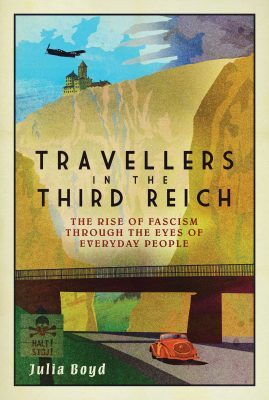
Travellers In The Third Reich by Julia Boyd


Leave a Reply!