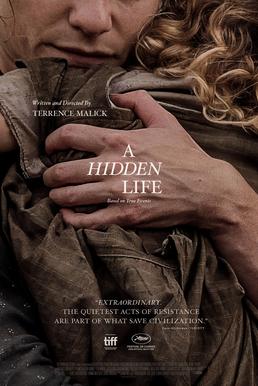
Directed by Terrence Malick, A Hidden Life tells the story of Franz Jägerstätter, an Austrian who refused to take the oath of allegiance to Hitler and fight on the side of the Nazis during the Second World War. Over a graceful, often profoundly immense two hours and fifty-four minutes, the viewer sees the impact of this decision upon Franz and his family. It is useful, I think, to understand the religious qualities of this film: it is a discussion of faith and what it takes to have it, to keep it, to let it lead you, and how to let others have theirs.
It’s of particular interest in how it depicts a quality of resistance rarely shown in movies. It is easy to find these stories in familiar settings and wrapped in familiar narratives: the brave, the bold, and somewhat more difficult to find them within the regime, so to speak. Malick does something incredibly interesting in how he represents language in the film. Characters speak in German and English, often in the same scene, and the German is not subtitled. Not only does this emphasise the distance and isolation felt by the characters in question, it also emphasises how much it does not matter what others might be saying. It is just noise, a voice in the distance, and a choice must be made whether or not to let yourself listen to it.
The voices which are heard, understood in this film are fiercely graceful things. The lead dynamic is between Franz (August Diehl) and his wife, Fani (Valerie Pachner), who have a loving, living relationship between them. Their life is small but immense, set amidst the mountains of Austria and on a farm full of backbreaking labour. Their family grows over their years, as does their love for each other. They play, they adore, they have pleasure in each other. They endure for each other, whatever the cost of that might be.
There is a sense of inevitability throughout this, led by Jörg Widmer’s poetic cinematography. Every shot is moving towards something, every shot has some sort of ending in mind, every shot hints towards a destination. Characters are hemmed in by the landscape about them. A window appears as a shot of light in the darkness. The bright blue sky ties one character to another. Light is important too: this film was shot without artificial lighting. The quality of light becomes another character. Rooms glow and become reminiscent of a painting by Vermeer or Rembrandt; walls bounce back the bright morning; the darkness closes in.
The last quarter of it is wildly moving, full of an agony that makes itself more felt with the restraint shown about the characters. Scenes are still, tight; hands are stretched across the table, touch becomes profound. The music is occasionally too heavy, too blunt, but it is forgivable because of the genuine nature of everything about it. The performances, the people, the inevitability of it all. It is awful. It is easy to ask yourself what you might have done in such a situation and be entirely unable to answer that question.
There is especial interest here to those of you who read The Chalet School books. The film is set in mid-twentieth century Tyrol and rural Tyrol at that, and gives you a vivid impression of what life really must have been like for people at that time. I found myself thinking about the difficulties of Winter and of how Zita, the St Bernard dog, is sent to the Chalet School because her owners could not afford to keep her. Great swathes of this film show people at work and it is backbreaking, endless stuff. People yoke themselves to the plough to pull it through the field, push through snow drifts to bring back wood for the fire, keep going even when the world is the very opposite of hospitable, of kind.
I am not especially familiar with Malick’s work, though I am familiar with him as a film-maker in that kind of way that one can be with cultural touchstones. I liked what he did here. I liked the simplicity of the story and the trust in his people to tell it. I understood, I think, for the first time, about the repeated refrain in the Chalet School books of: “I shall lift up mine eyes unto the hills”. It is not a quick film, nor is it particularly wanting to be quick; there is something particularly deliberate about it, a resistance to be told in another way than what it is.
I find myself thinking about Sylvia Plath as I write this, and in particular a quote of hers from The Bell Jar (1963): “I took a deep breath and listened to the old brag of my heart: I am, I am, I am.”


Leave a Reply!