My rating: 4 of 5 stars
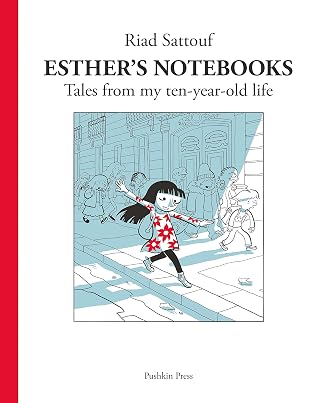
There’s a lot of incredibly interesting layers to this apparently simple thing and the more you think about it, the more the layers reveal themselves. Esther’s Notebooks is based on a series of conversations between Riad Sattouf and his friend’s daughter, ten year old Esther, about her life and everything that goes on in it. The resulting one page comics were originally published in a magazine before being gathered up into this edition and others: subsequent volumes are from eleven, twelve, thirteen and fourteen year old Esther. Accordingly, there’s the mark of that original publication about them: they are self-contained, instant little snapshots of a young person’s life in Paris with her “idiot” brother, her “very nice” mum, and her “I love him so much” Dad.
And at first, you can think this is one thing: that the style is cute and soft, that the focus is a little scatter-brained, and that there’s not that much to say here other than Esther will do anything for an IPhone and that playground politics are a hard thing to manage wherever the playground might be in the world. But then the comics start to reveal themselves and expose the, kind of, precarity of childhood life and how it comes into contact with the world around it. A landmark page deals with the impact of the Charlie Hebdo attacks; another standout sees the classroom start to ask questions about the potential racism of Joan of Arc, and another sees a child deal with the impact of parental loss.
And I think what makes these work and what makes them so interesting is that this is what childhood is like, that there are elements of the fictional and the artificial about it and that the presence and the role of the cartoonist himself has a resonance upon the page that needs to be figured out (is it exploitative? Transformative? Witnessing? Documentative? Sometimes it’s all of these and none, sometimes it’s more and it’s kind of fascinating to work it out) and then you start to figure out the form of Esther’s original story to the artist and kind of realise the moments where it moves into something fictive, otherworldly.
It is interesting this, it’s funny and it’s wry, and it’s startlingly acute, not in the least about ideas of sexuality and gender. Esther’s playground is marked by some graphic discussions about love and relationships and it’s often challenging and difficult to come across. Yet Sattouf doesn’t shy away from this: he presents the panels with a direct immediacy and isn’t afraid of letting moments happen. It is a snapshot of a group of young people marked by the discourse all around them before, in many senses, they’ve even begun to speak.
A powerful, deceptive thing this and one which poses some big questions. I’ll look forward to picking up the sequels.
View all my reviews
Esther’s Notebooks by Riad Sattouf
Responses
-
I’m intrigued enough by your enticing review to want to chase it up now, thanks.
-
I’m after the sequels as we speak!
-


Leave a Reply!