My rating: 5 of 5 stars
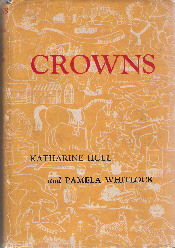
Well known for their first novel, The Far Distant Oxus, written when both Katharine Hull and Pamela Whitlock were schoolgirls, Crowns is their last effort (I think?) in their joint writing career, published in 1947, and dedicated to the author who began it all for them: Arthur Ransome. It is, I suspect, somewhat overshadowed by that first book with all its eye-catching discourse about the authors being so young and Arthur Ransome being their fairy bookfather, so to speak, and so here is the point where I move away from that and tell you two things: I think Crowns is better than Oxus, and in fact, I think it’s occasionally brilliant; and I think that this is a story that needs to be In The Discourse a lot more than its light internet footprint seems to suggest.
So let’s start there, with making that footprint a little bit clearer.
Crowns is broken up into three parts and centres on four cousins: Eliza, Andrew, Charlotte and Rob. Part One begins on December 19th, as the children come home from school to begin their Christmas holidays, and ends on Boxing Day. It’s at this point that the undated Part Two kicks in, and it’s almost twice as long as what’s come before. Part Three then takes over and returns to Boxing Day. As you might gather by this, something rather interesting happens in Part Two and that is this: the children fall into another story. Technically, I suppose, it is an imagining, driven by a game during a Christmas party in which all four of them end up hiding in the same space, but in many ways, this flattens the moment. This is real and the children know that it is real, and after a moment of orientation, you know it as well. Something has happened here; the children have slipped from one world into another where they are kings and queens and able to, at last, choose their own destinies.
There’s something so interesting here and it begins from the early pages with its Streatfeild-esque stories of families coming together over the festive period but also in the sheer, raw confidence of the authors. I believe that Hull and Whitlock wrote alternating chapters in Oxus so I wonder if that way of work continued here; either way, they are on form and this is full of such confidence that you can almost feel it on the page. There is something fascinating here, something good. Something so, so strong. Consider Charlotte’s response, for example, when she’s asked about a question in her exam (on the first page!): “Did you do question six?” Her reply: “No, number seven.” She rolled a scarf round her face like a visor so that only her eyes peeped through; she was more interested in her secret thoughts than in algebra.” I mean, the character work here. The absolute confidence in character, in saying enough and letting the character take centre stage. On. Page. One.
This is a good book. It’s occasionally, as I say, brilliant. I think there’s hints of Elidor here and of the The Chronicles of Narnia books too and even, the distant suggestion of something almost Susan Cooper-esque. They are big names to invoke and I do it quite deliberately because Crowns is a very specific kind of British fantasy in which the edges of the world blur and something else starts to be found within them. This is Hull and Whitlock’s last book (again, as far as I am aware?), and it’s their best and it’s so sad that this was it. They were on their way to somewhere great.
I am at the risk of writing an essay about Crowns and yet, I want to. There is something so exciting about finding a book like this, something which confounds expectations and gives you something quite unexpected. Itself. And so, perhaps, we need to finish this with an acknowledgement of where it falters, because it is not, despite what I might have suggested, a perfect thing. There are some moments which stretch a little too long, some moments which are a little too circuitous, and some which, as with other similar texts from this period, have not aged well. A plot involving Charlotte’s adventures in unknown lands, towards the latter half of the book, is particularly at fault here, and there is a problematic element or two in the endpapers which, were this republished now, would be rightfully addressed. I was reminded, when reading, of both the representation of the Calormenes in the Narnia books and the subsequent discussions about those characters, and I think some of that would be useful here.
And so there we are, the outline made, the footprint trod, and if there is discussion about this book elsewhere that I have missed, please point me towards it for I may have missed it; this period is a specialism of mine but fantasy is not, and so – this is a contribution, I hope, towards this story being discovered by new readers and in that discovery to be reminded of the boldness of children’s literature, the brilliance of it, and to learn that two authors who first stormed onto the scene as schoolgirls were not there just because of their age. They were there because they could write and this is their testimonial and it is good.
View all my reviews
***
Thank you for reading! If you’d like to support my reviews, you can micro-donate or purchase any of my books through this handy Bookshop.Org affiliate link. And if you’d like to read more brilliant books, then why not start with a look at the very undersung The Last Weapon by Theodora Wilson Wilson or the award winning The Lord of the Flies graphic novel by Aimée de Jongh…


Leave a Reply!