There are some titles and authors that you see a lot of in the vintage children’s book section in the old second hand book shop. (And if there is not a vintage children’s book section, then you must forgive them for they know not what they miss). Those authors, particularly in the UK, tend to be people like Enid Blyton and – actually, I was going to list a fair few other names here but I think really it’s just Enid Blyton. I am reading the very good Enid Blyton: A Literary Life (affiliate link) at the moment and I’m struck by the actual amounts of books she had published: in October, 1951, she writes of the first print run of Seven Bad Boys being 50,000 and a reprint being due out before Christmas (p.190), and these numbers aren’t unusual. So quantity lasts, endures, and you find these books sixty, seventy years later because there are simply so many of them.
There are other books which endure, of course, outside of the Blyton Paradigm. Titles like The Secret Garden and Little Women are perennial favourites and authors like the Pullein-Thompsons are regular names. Some of this stems from reprints, of course, but also from the great, pocket money friendly work of Armada as a publisher who pounded out a vast amount of popular reprints and fresh titles in the sixties. But then, there are authors and titles who you don’t find that easily. The rise of the internet and the visibility of book collecting was one factor: many rarer titles are now sent towards online retail or displayed in glass cabinets at three figure sums that made childhood me twitch and back away slowly.
And then there’s the rarities: the books which appear rarely, shyly, which never really show and when you do find them, it’s a delicious, storied moment. I remember finding a clutch of Joyce Stranger books many moons ago in a Whitby charity shop; the five or six of them hanging together in a kind of echo of what they once were, unable to find a connection with the bright covers about them. And then there’s the moments when you find a Beaver Towers book by Nigel Hinton in a city you’d never been in before and realise that the series you half-thought you’d hallucinated was, in fact, a real thing.
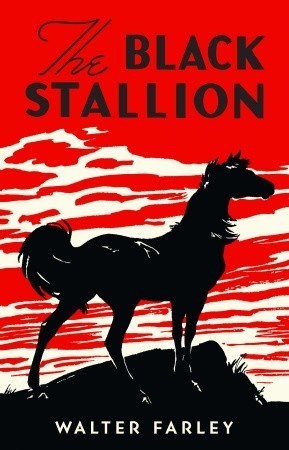
The other week I came across an enormous bundle of the Black Stallion books. I’ve looked at the original and its film adaptation before but it’s been a long while since I’ve read all of them, together. And to find nearly the entire series on the shelf together? Interesting. I bought them. I couldn’t not, really. Collecting second hand books has taught me that you must always – if you can – pick up the interesting things. The weird stuff. The (almost) full runs of a series. Once I found the entire run of the Drina books in a bookshop and almost fainted from over-excitement (that was a very good day).
Rereading any series is a curious thing, particularly when you do a lot of them in quick succession. They have their tics, their styles, and their way of doing things. There is often a moment, early doors, when one character says to the other: “Don’t you know who [Lead Character] is?”, and then the other helpfully says: “No I don’t, tell me more!” and so the series to date is recapped and everybody can start on an equal footing. In the case of the Black Stallion books, every book has at least one dude who’s incredibly into horse-racing so able to fulfil this requirement. Which is kind of outstanding, really.
I’ve also been struck by the leanness of these books. They are spare, sparse things. In terms of word-count, they seem to hover somewhere around the 45,000-50,000 word mark. To give you some idea of comparatives here, the unabridged Secret Garden runs at 80,398; When Hitler Stole Pink Rabbit sits at 55,838 and my How To Be Brave sits at 54,879 (Word counts checked via ARBookfinder which is also an excellent resource for those of you who are working on writing of your own). There’s also a connection here to Enid Blyton for me; both Farley and Blyton share this kind of determinedly driven, barely there aesthetic in their work. They will get their reader to the end and they’ll give you some high drama on the way and they won’t stop for anything.
There’s another connection here that’s needling at the edges of my senses and it’s about the mother figures. These aren’t particularly women heavy stories so far (caveat: I’m halfway through my reread so that might change) but I am struck by the representation of Mrs Ramsay. There is a kind of delicate sense of loss about her, of grieving in plain sight for her son as she thought he might be, and of dealing with a profound sense of trauma. The latter is quite understandable because this lady goes through it: so far, Alec’s been lost in a shipwreck, apparently killed in a plane crash, injured himself in a variety of eye-catching fashions, and I’m only up to book five. So Mrs Ramsay goes through it but she does in a way which reminds me, very much, of Nell McLaughlin from the My Friend Flicka books by Mary O’Hara. I think there’s a paper here to figure out on motherhood as represented in the background of these big, boy-centred pony stories, and that will be something to come back to in the future.
These books are pulpy, driven, madly determined things. Not all of them work for me now but that’s the nature of rereading things, particularly when the books are from a particularly time period. Some of the stereotypes are heavy, and there’s an unfortunate habit of giving one character a pronounced accent in his speech which I have never wholly enjoyed.
In any rereading, you engage with the reader that you were before. You remember the text in a half-formed way and come to it with that knowledge, those memories. I remember thinking enormously about how much I would want every inch of Alec’s life but also, about how much I would have died within minutes of being on that island and about how the thought of riding The Black was, in fact, terrifying. But that’s the way of a good pony book I think (see also the Jinny books by Patricia Leitch); it makes you want every inch of that life even if you know how enormously unsuited you would be to that. It makes you imagine. It makes you dream. And there’s something kind of remarkable in being able to come back to those dreams a hundred years later and realising that they’re still there. That you’re still in that stable with Napoleon and The Black at your side. That they’ve waited for you. That they will always wait for you.
I love that, enormously. Endlessly.


Leave a Reply!