My rating: 4 of 5 stars
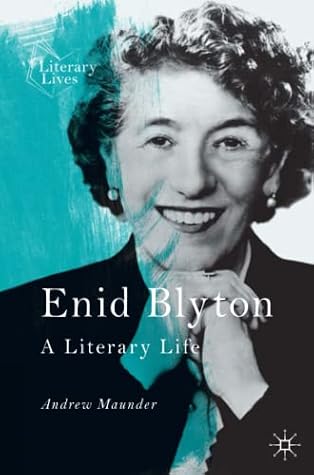
Reckoning with Enid Blyton is, I think, one of the key things that you have to do if you’re interested in how children’s literature works. As a researcher, a reader, and writer in this area, I’ve spent a long time trying to figure this complex and often challenging figure out. I don’t think I’ve remotely begun to answer that question. The more I think about her and the more I read her, the more I realise that there’s more to say. And, if I’m honest, the more I rail against binaries when reading her: this is a writer who doesn’t sit easily within simple, definite classifications. She was good, she was bad, she was brilliant, she was mortifying, and sometimes all of that at once. And isn’t that interesting? That such figures can come to the forefront of children’s literature and even now, over fifty years after her death, still mark and guide what we think of the sector today?
What’s perhaps more interesting is how difficult she is to write about. For some, she slides into a box never to be opened and at some level, that’s a valid reading of her work. I mean, I’ve finished a vast amount of Blyton books and thought: what. was. that. But also, it’s a limited reading, as Maunder swiftly makes clear in this remarkably comprehensive overview of Blyton’s work: this was a writer of contradiction and there is interest in that. There is interest in pulling Blyton from the thickly layered and well-established discourse about her and instead saying: who was this woman and what did she do and how did she do it? This is not to say that people have not done that before (and indeed done it well – I think of people like David Rudd, for example) but rather to find interest in the calmly ambitious heart of this book and its distinct effort to say something new. He is interested in what Blyton does as a writer. As an author. As a professional creative. And how we can understand that without reading it through the filter of ‘Blyton’.
This book is hampered by its ambition at times, and some of this stems from the subject. Blyton was so prolific, so markedly present, that to attempt to review everything that she wrote is to inevitably remain at the surface level of the content. Occasionally Maunder dives down with some intriguingly provocative reads which, even if I did not agree with them, I still found interesting to have laid before me (and would have welcomed much more of). I am not sure I quite agree with Blyton practicing a form of l’écriture féminine, for example, nor am I quite convinced that Blyton had Anne down as a form of ideal femininity. There was a lightness of reading about gender throughout the text, but some acute commentary about housewifes, and I suspect some of this may come from space pressure: it is impossible to say everything. Yet I think it would have been productive to shift some more attention towards these issues, eternally present as they are in Blyton’s work.
Having said that though, it is important to note that Maunder delivers a remarkably thorough academic reading of Blyton, ranging from the expected references but also including her television, theatre, and legacy. Along the way we get some outstanding titbits of information which would really sustain an entire book by themselves: the beef between Alison Uttley and Blyton has given me life for days as has discovering that Blyton was asked to testify at the Lady Chatterley trial. I mean, can you imagine? (I am imagining. Trust me, I am imagining).
I have read other books about Blyton and some of them have been ferociously reductive. This is not that. It is enormous.
View all my reviews
***
Wanting more Blyton content? Why not start with my podcast episode entirely devoted to her…


Leave a Reply!